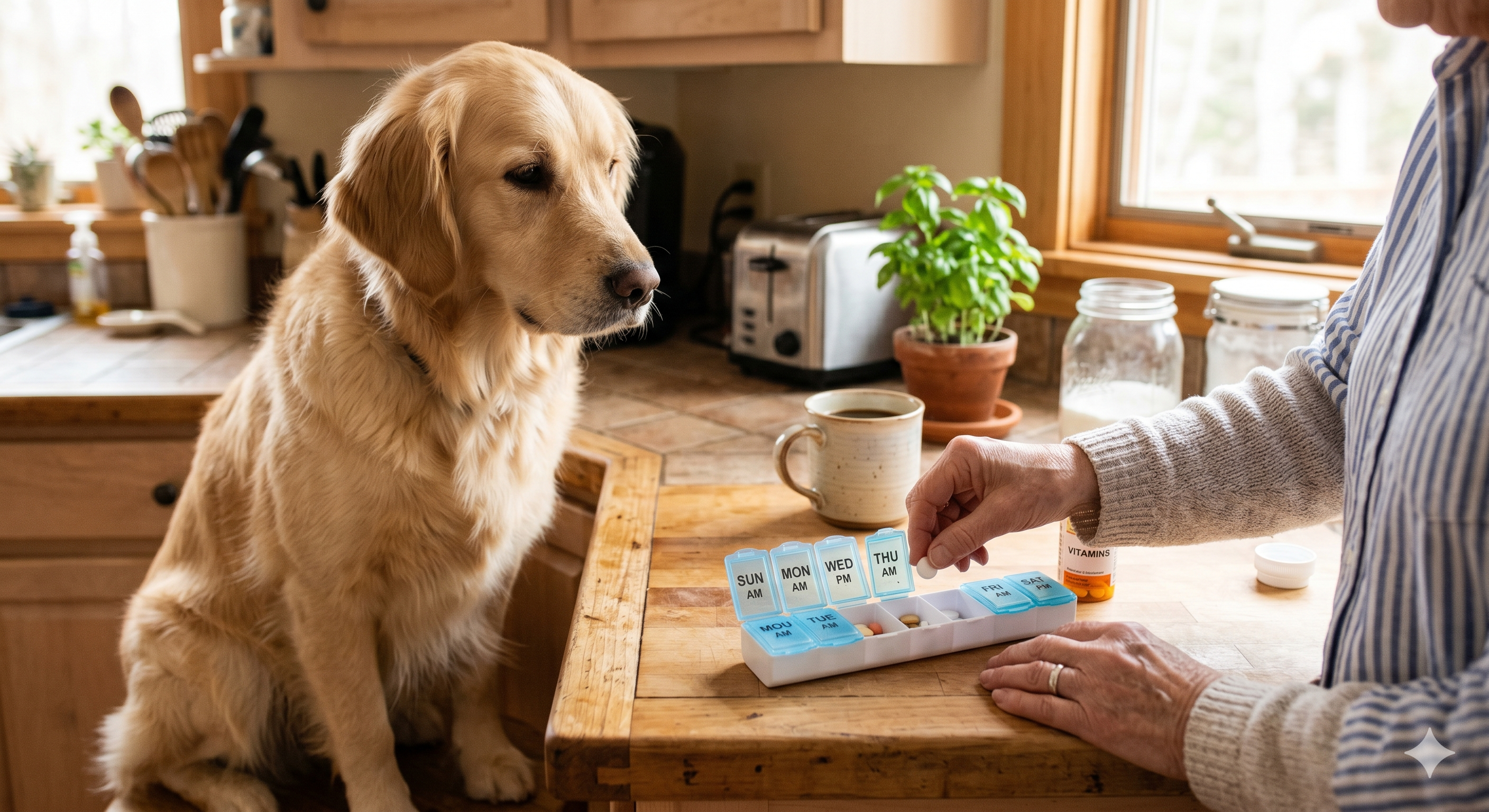
How to Track Your Pet's Medications (Without Missing a Dose)
Missing a single dose of antibiotics can let bacteria rebound and restart an infection from scratch. Forgetting a monthly heartworm pill can leave your dog completely unprotected. And if you're managing more than one pet, or sharing care with a partner or pet sitter, keeping it all straight in your head is a genuine risk.
None of this is a willpower problem. It's a systems problem, and it has a practical solution.
Why missed doses happen more than people admit
Most pet owners are well-intentioned. The problem is that life interrupts. A medication given "twice daily with food" sounds simple until you're running late for work or genuinely unsure whether your partner already gave it that morning.
Monthly preventatives are even harder. There's no daily habit to attach them to, and because missing one doesn't produce an immediate visible consequence, it's easy to let a month slip. The American Veterinary Medical Association identifies medication non-compliance as one of the most common and underreported problems in pet health. Owners who missed doses often don't mention it at the vet because they feel embarrassed.
What a reliable system actually needs
Most people rely on a phone alarm or calendar reminder. That covers the first part of the problem. But a complete system needs three things working together:
- A scheduled reminder that fires at the right time without you having to think about it
- Confirmation that the dose was given, not just that the reminder fired
- Shared visibility so that anyone else involved in your pet's care can see the same information in real time
Without confirmation and shared visibility, you still end up with the two most common failure modes: assuming someone else gave it, or giving it twice because no one could be sure.
What to record for every medication
For each medication your pet is on, keep a complete record:
| Field | Why it matters |
|---|---|
| Name and dosage | Vets need the exact dose, not just the drug name |
| Frequency | Daily, twice daily, monthly, as needed |
| With food? | Missing this instruction can cause vomiting or reduce absorption |
| Start and end date | Critical for courses like antibiotics |
| Who prescribed it | Useful if you switch vets or need a refill |
| Dose log | Every dose given, with a timestamp and who administered it |
The dose log is the field most people skip, and it's the most valuable. It's what lets you answer "when was her last dose?" with certainty, and it's the only real safeguard against the double-dose problem when multiple people are involved.
Different medications, different challenges
Daily or twice-daily medications
These are the easiest to set reminders for but the hardest to maintain over long courses, especially for chronic conditions like thyroid disease, epilepsy, or diabetes. A dog on phenobarbital twice daily for seizure control needs that medication consistently for life. One missed dose usually won't cause a crisis, but irregular dosing reduces effectiveness over time and makes the condition harder to manage.
The goal with these is making administration as frictionless as possible: a reminder at a consistent time, pill pockets or food to make it easy, and a quick way to log it as done.
Monthly preventatives
Heartworm prevention, flea and tick treatments, and some deworming medications are given once a month. These are the most commonly missed, because there's no daily habit to anchor them to. Picking a specific recurring date (the 1st of every month works well) and treating it as non-negotiable is the most reliable approach.
Worth knowing: Heartworm disease is preventable but not curable in the conventional sense. Treatment is a months-long process that's hard on the dog and expensive. The American Heartworm Society recommends year-round prevention. Consistent monthly dosing costs a fraction of what treatment does.
Short courses (antibiotics, steroids)
The biggest risk with short courses is stopping early because your pet seems better. Antibiotics need to be completed in full. Stopping when symptoms improve leaves surviving bacteria behind and contributes to antibiotic resistance. Set a reminder for every dose and an end-date alert so you know when the course is done.
As-needed medications
Pain medications, antihistamines, or anxiety medications given situationally are the hardest to track because there's no fixed schedule. Logging each dose matters most here, both to avoid double-dosing and to give your vet an accurate picture of how often they're being used.
The double-dose problem
In households with multiple caregivers, this is surprisingly common. You ask your partner "did you give Charlie his pill?" and they're not sure, so you give it to be safe. Or you both independently give it in the morning without realising the other already did.
For many medications a double dose is harmless. For others, including NSAIDs, seizure medications, and thyroid medications, it can cause real harm. A shared log that shows who gave what and when is the only reliable fix.
Multiple pets
If you have two or more pets on different schedules, the complexity multiplies. A dog on monthly heartworm prevention, a cat on a twice-daily thyroid medication, and a rabbit on a short antibiotic course is not an unusual situation. Keeping it all in your head while running a normal life is genuinely difficult, and the consequences of mixing things up are real.
A separate record for each pet, with its own reminders and dose log, is the only approach that scales.
What the system should do
Whatever tools you use, your medication tracking setup should cover:
- A reminder at the right time for every scheduled dose
- One-tap confirmation that the dose was given
- A log you can show your vet with dates, times, and doses
- Shared access for anyone else who cares for your pet
- Separate records for each pet
- Alerts when a course ends or a refill is coming up
A spreadsheet or notes app can handle parts of this. A pet care app built for medication tracking handles all of it, and keeps the history alongside vet records and vaccination info so everything is in one place.
Set it up once, never miss a dose again
Pett lets you create medication schedules, get reminders, log doses with one tap, and share access with your whole family. Every pet, all in one place.