How to Give Your Cat Medications (and Actually Track Them)
Cats are not small dogs. The strategies that work reliably for medicating dogs, pill pockets and mixing into food being the most obvious, often fail entirely with cats. A cat that decides it does not want to take a pill is remarkably effective at that decision. And a cat that spits out or buries a pill without you noticing means a missed dose you believe was given.
The administration challenge is compounded by the fact that cats are good at hiding illness, which means many cats only start needing regular medication in middle or old age, when conditions like hyperthyroidism, kidney disease, and diabetes become common. Getting medication into a cat twice daily for the rest of its life requires a system that actually works for that specific cat.
Administration methods
Pills and tablets
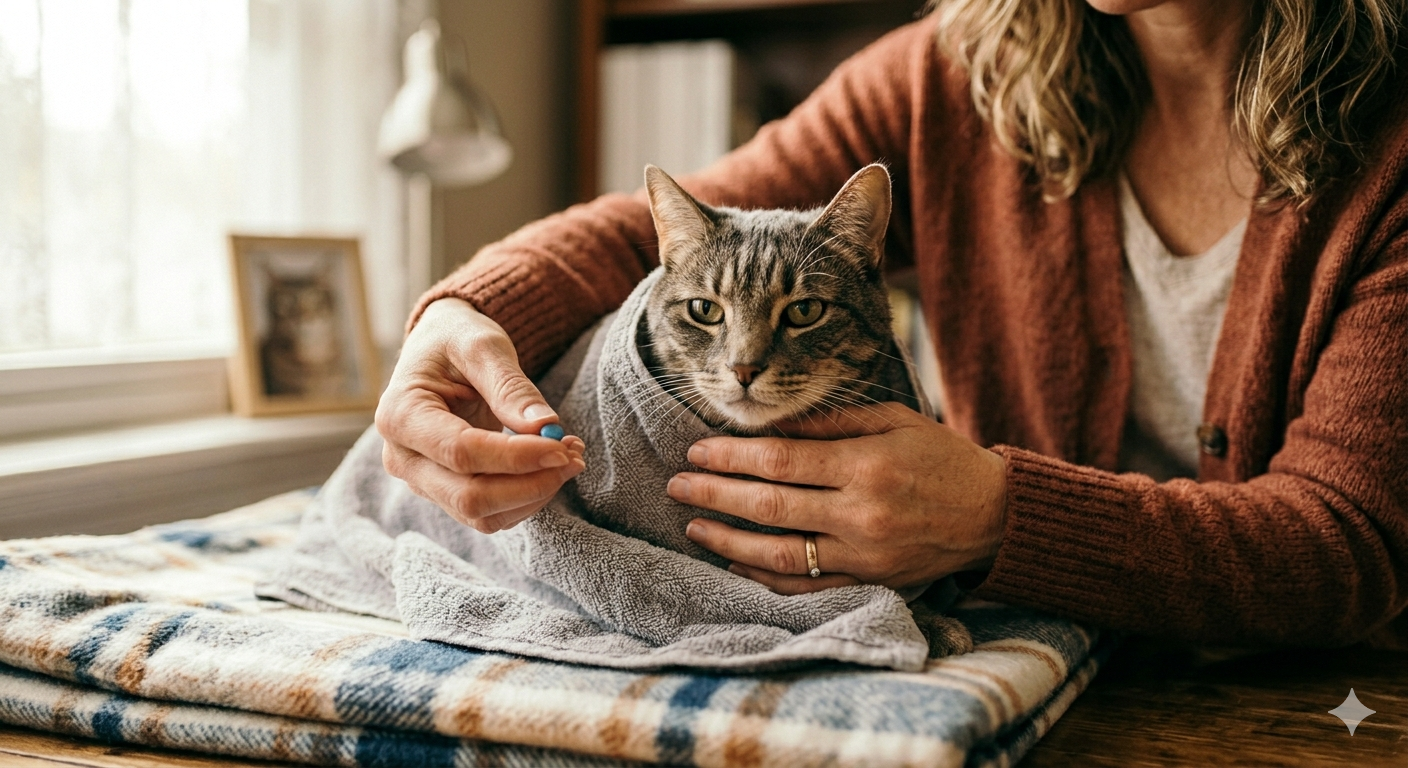
Direct pilling (opening the cat's mouth and placing the pill at the back of the throat) works reliably when done correctly. Your vet can demonstrate the technique. The key steps are tilting the head back, opening the mouth by pressing on the sides of the jaw, placing the pill as far back as possible, closing the mouth, and gently stroking the throat or blowing on the nose to trigger swallowing. Following with a small amount of water from a syringe helps the pill move down and prevents esophageal irritation.
A pill gun (also called a pill popper) is a syringe-style device that places the pill at the back of the throat without putting your fingers in the cat's mouth. Many cats tolerate this better than direct pilling, and it reduces the chance of being bitten.
Pill pockets work for some cats but not all. Cats are significantly more sensitive to bitter tastes and texture changes than dogs, and many will eat around a pill concealed in food or spit it out after eating the treat. If pill pockets work for your cat, excellent. If your cat is suspicious of them, do not rely on them.
Liquid medications
Liquid medications are given with a small oral syringe, directed into the side of the mouth (not down the throat, which causes choking). Some cats tolerate liquids better than pills. Others find the taste or texture objectionable. Compounding pharmacies can flavor liquids to make them more palatable, with options like chicken, fish, or tuna often being more successful than the base formulation.
Transdermal gels
Some medications can be compounded into a gel that is applied to the inner surface of the ear flap, where it absorbs through the skin. Methimazole (for hyperthyroidism) is the most commonly prescribed medication in this form. Transdermal administration avoids the mouth entirely, which is a significant advantage for cats that resist any oral medication. Absorption is somewhat lower than oral administration, so doses are typically adjusted accordingly. Your vet will prescribe the appropriate transdermal dose if this is the right approach for your cat.
Ask your vet about compounding. Many medications can be compounded into a different form, concentration, or flavor. If the prescribed form is not working for your cat, this is worth raising explicitly. A cat that consistently refuses medication is receiving no benefit from the prescription.
Common chronic conditions requiring ongoing medication
| Condition | Common medications | Typical administration |
|---|---|---|
| Hyperthyroidism | Methimazole (Felimazole) | Twice daily, pill or transdermal gel |
| Chronic kidney disease | Phosphate binders, anti-nausea, subcutaneous fluids | Varies; some require home fluid administration |
| Diabetes | Insulin (Vetsulin, Glargine) | Subcutaneous injection twice daily with meals |
| Inflammatory bowel disease | Prednisolone, B12 injections | Oral or injection; schedule varies |
| Hypertension | Amlodipine | Once daily, pill or compounded liquid |
| Arthritis | Solensia (monthly injection at vet), Meloxicam | Monthly clinic visit or daily oral |
Tracking when a dose was actually given
With cats, the difference between "I gave the medication" and "I believe I gave the medication" matters more than it does with dogs. A dog enthusiastically eats its pill pocket. A cat can leave the room with a pill in its cheek and deposit it elsewhere. Until you see the cat swallow and you have confirmed it stayed down, the dose may or may not have been given.
Logging doses immediately after administration, not at the end of the day, is more accurate. It also resolves the shared-household uncertainty problem: a partner who goes to give the evening dose can see from the log that the morning dose was given, and vice versa.
Monthly preventatives for cats
Monthly flea prevention, and in some cases heartworm prevention (cats in high-risk areas are sometimes prescribed Revolution), follows the same scheduling challenges as dogs. Picking a fixed date each month and treating it as a standing routine reduces the chance of letting a month slip. Logging each application means you have a record if a boarding facility asks when the last dose was given.
What to record for each medication
- Medication name, strength, and formulation (pill, liquid, gel)
- Dose amount and frequency
- Whether to give with food or on an empty stomach
- Start date and, for short courses, end date
- Prescribing vet and clinic
- Log of each dose given with timestamp
- Notes on tolerance: does your cat accept it, spit it out, vomit after?
The tolerance notes are worth keeping because they give your vet specific, actionable feedback. "She takes the pill fine" and "she spits out the pill about 30% of the time and I can't always tell" are very different situations requiring different responses.
Track your cat's medications in Pett
Schedule reminders, log each dose, and share access with whoever helps care for your cat. Free to download.